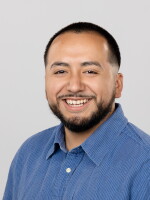
The wife of a SUNY Brockport IT technician is questioning what led ICE agents to target the Venezuelan husband and father this week as he left for work.
“We did not came other way,” Maria Velázquez told WXXI News, referring to her own arrival but also that of German Machado Guillen and their now two adult sons. “We came legally with a legal visa, with legal passports. We did everything according to immigration law at the moment.”
Velázquez was in New York City visiting the couple’s eldest son when they learned of Machado Guillen's detention. He was allowed a 2-minute phone call from lockup.
U.S. Immigration and Customs Enforcement agents took Machado Guillen into custody on Tuesday morning, without warning, from outside his family home in Batavia, according to United University Professions, the union representing him at SUNY Brockport. The family later returned to find the scene unsecured.
“We found his lunchbox in the car,” Velázquez said. “The car was open, but everything inside the house was in order. We are assuming that he was opening the car, getting into the car when he was interrupted by ICE agents.”
In a statement, an ICE spokesman said Machado Guillen's detention was part of a "targeted enforcement action," and alleged that the university staffer had overstayed his visa and remained living in the United States illegally, though with a valid work permit, for nearly a decade. Machado Guillen arrived in the country in 2016, and his initial authorization was for six months, through February 2017.
“To be clear,” the ICE statement read, “work authorization or a pending application does not confer legal status in the U.S.”
The federal action has shaken the upstate campus. And raised further challenges to the administration's underlying goal for its immigration crackdown.
Velázquez said that at the time Machado Guillen was arrested he had a valid Employment Authorization Document to work at SUNY Brockport that expires in 2029. He is also listed on Velázquez’s pending asylum application as well as their two sons.
An EAD is issued by the U.S. Citizenship and Immigration Services and allows a noncitizen to legally work in the U.S. for a specific period of time.
The document does not, by itself, establish a person’s immigration status or authorize them to remain in the country — a point ICE highlights in its statement.
Velázquez says she believes the family's asylum application protects her husband and sons from removal.
"When we applied for asylum, my husband and both my kids are protected," Velázquez said. "That's how it works. My family is protected on my petition. So my husband is also legal here. My two kids are legally here."
The distinction between a pending asylum application and lawful immigration status is central to the family's account of Guillen's detention. Velázquez maintains that the family has followed the immigration process and applied for asylum before the period of authorized stay expired.
The Trump administration's immigration crackdown began with a message of deporting the worst of the worst. But as arrests have surged in recent months, targeting people with no criminal histories or final orders of removal, the administration has said criminal history and pending residency arguments for legal pathways are not a consideration.
Velázquez said she briefly spoke with her husband on Tuesday. He told her he was doing ok, she said, but she had not spoken with him again as of Wednesday afternoon.
“I cannot say for sure if he's okay, if he has eaten, if he's been treated well, I don't know,” Velázquez told WXXI News.
Despite the uncertainty surrounding her husband's detention, Velázquez said she continues to believe in the judicial system of this county.
"We are doing everything we have to do in order to be good citizens," Velázquez said. "We are not criminals. We are paying taxes. We are working."
Machado Guillen is being held at the Buffalo Federal Detention Facility in Batavia.
Why the family fled Venezuela
Velázquez, a journalist, said the family fled Venezuela in 2016 because of threats and violence they experienced under the government of then- President Nicolás Maduro.
She said they fled the country after government officials repeatedly threatened her family and physically assaulted her because of her work as a journalist.
“My kids were threatened in our house,” Velázquez told WXXI News. “My car windows were broken. I received threats on my radio show, and the last thing they could do to me was beat me while I was reporting in the main hospital of my city.
She said the assault left her with a serious back injury to this day.
In May 2016, Velázquez decided to go to stay with her late father in the U.S. while waiting to see if the situation in Venezuela improved. Her father, who has since died, was a U.S. citizen who had lived in the country on and off since 1976 working as a journalist for CNN and Voice of America, according to her son Samuel Machado.
She said her husband and sons continued receiving death threats in Venezuela, prompting the family to leave the country and join her in the U.S.
In late August 2016, Machado Guillen, along with his sons, arrived at the John F. Kennedy International Airport in New York City on B-2 visitor visas, Velázquez said. Those visas are for people who want to enter the U.S. temporarily for business, tourism, or a combination of both.
Velázquez said that three days later, on Sept. 2, 2016, she filed an application for asylum and for withholding of removal as the principal applicant. She marked her husband and two sons as dependents on the application.
“We did everything the law requires a person who needs to apply for asylum,” Velázquez said. “Our visa did not expire before we applied for asylum. I waited for both my kids and my husband to come to the U.S. to apply for asylum. When we applied for asylum, they still had five months and 15 days on their visa.”
People who have the B-2 visa can travel to a U.S. port-of-entry like an airport and request permission to enter the country. Department of Homeland Security and U.S. Customs and Border Protection officials have the authority to approve or deny admission to the U.S.
ICE said Machado Guillen was authorized to remain in the United State until Feb. 27, 2017, and that he overstayed that period. Machado maintains that the family filed for asylum before its authorized stay expired.
“We have been abiding by an affirmative process, not a defensive process," Samuel Machado said. "What that means is that we have never gone ahead of breaking any rule and then defend ourselves against breaking the rule. We have done things in advance of breaking anything. We don't want to break any law or rule on immigration. So it is very important that we emphasize that because we are not, we are doing everything that we're supposed to do."
Includes reporting by staff writer and editor Brian Sharp.